By Marcelo Salamon
08.06.2026
Resumo
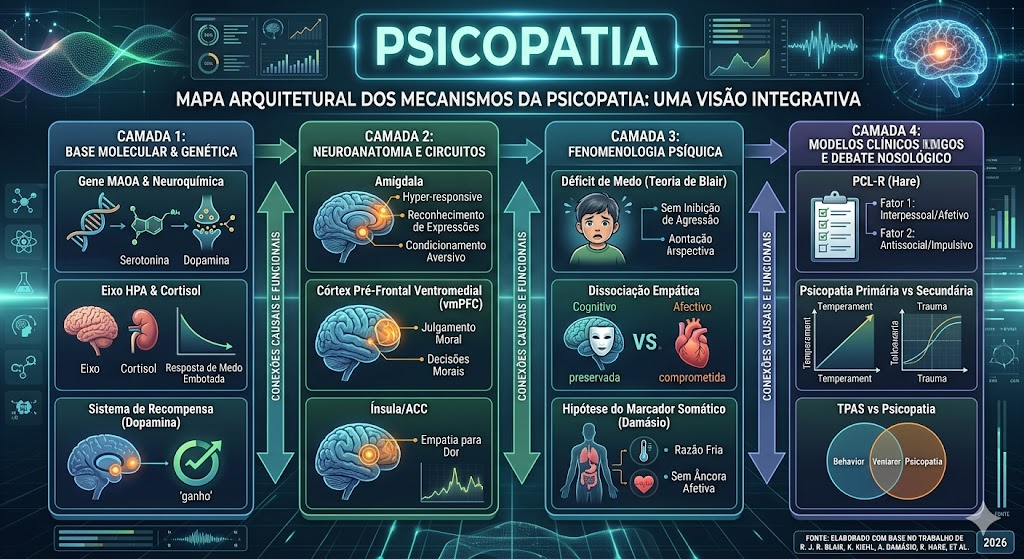
Este artigo realiza uma revisão integrativa dos mecanismos físicos, neurobiológicos e psíquicos subjacentes à psicopatia, abrangendo quatro camadas de análise: molecular-genética, neuroanatômica, fenomenológica e nosológica. A síndrome representa uma condição neurobiológica de alta complexidade, cujas determinantes atuam em múltiplos níveis de organização biopsíquica.
1. Introdução
A psicopatia, situada na interseção entre o normal e o patológico, manifesta-se como uma organização singular da experiência subjetiva, cognição social e regulação afetiva, sustentada por um substrato neurobiológico identificável. O objetivo deste trabalho é cartografar os eixos de evidência contemporâneos, transcendendo descrições meramente taxonômicas em favor de modelos mecanicistas.
2. Metodologia: Quatro Camadas de Análise
A análise estrutura-se em uma abordagem vertical de descrição:
2.1. Camada Molecular — Genética e Neuroquímica
- Genética: A herdabilidade dos traços callous-unemotional (CU) é estimada entre 0,45 e 0,65.
- Neuroquímica: O gene MAOA (de baixa atividade) é associado a comportamentos agressivos em contextos de adversidade infantil.
- Eixo HPA: Observa-se hiporresponsividade do eixo hipotálamo-pituitária-adrenal, resultando em menor liberação de cortisol sob estresse.
- Dopamina: O sistema mesolímbico apresenta hipersensibilidade à antecipação de recompensas.
2.2. Camada Neuroanatômica
- Amígdala: Apresenta redução volumétrica bilateral e hiporresponsividade a expressões de medo e sofrimento.
- Córtex Pré-Frontal Ventromedial (vmPFC): Exibe hipoativação em tarefas de julgamento moral e antecipação de consequências.
- Circuito de Empatia: A ínsula anterior e o córtex cingulado anterior (ACC) mostram atividade reduzida durante a observação de dor alheia.
2.3. Camada Fenomenológica
- Déficit de medo: A falha no condicionamento aversivo impede que sinais de angústia alheia funcionem como inibidores da agressão.
- Dissociação empática: Existe uma distinção clara entre a empatia cognitiva (preservada) e a empatia afetiva (comprometida).
- Marcador Somático: A desconexão entre amígdala e vmPFC gera uma “razão fria”, onde a lógica instrumental prevalece sobre a ancoragem afetiva necessária para decisões sociais e morais.
2.4. Camada Nosológica
- PCL-R: A Psychopathy Checklist-Revised de Robert Hare permanece como padrão-ouro, dividindo o construto em Fator 1 (interpessoal/afetivo) e Fator 2 (comportamento antissocial/impulsivo).
- Debate Taxométrico: Evidências sugerem que os traços psicopáticos se distribuem em um continuum na população, não como uma categoria discreta.
3. Considerações sobre Tratamento e Neuroética
Embora historicamente considerada intratável, intervenções precoces em crianças com traços CU, focadas em reforço positivo, demonstraram eficácia superior a métodos punitivos. O uso de neuroimagem em contextos forenses levanta questões complexas de neuroética, desafiando noções de livre-arbítrio e a base do sistema penal.
4. Conclusão
A psicopatia não é um “mistério do mal”, mas um fenômeno científico multifacetado. A integração das quatro camadas de análise é essencial para superar o reducionismo e compreender a organização fenomenológica distinta desses indivíduos.
Referências Bibliográficas
Babiak, P., & Hare, R. D. (2006). Snakes in suits: When psychopaths go to work. HarperCollins.
Blair, R. J. R. (2005). Responding to the emotions of others: Dissociating forms of empathy through the study of typical and psychiatric populations. Consciousness and Cognition, 14(4), 698–718.
Blair, R. J. R. (2013). The neurobiology of psychopathic traits in youths. Nature Reviews Neuroscience, 14(11), 786–799.
Buckholtz, J. W., et al. (2010). Mesolimbic dopamine reward system hypersensitivity in individuals with psychopathic traits. Nature Neuroscience, 13(4), 419–421.
Caspi, A., et al. (2002). Role of genotype in the cycle of violence in maltreated children. Science, 297(5582), 851–854.
Craig, M. C., et al. (2009). Altered connections on the road to psychopathy. Molecular Psychiatry, 14(10), 946–953.
Damásio, A. R. (1994). Descartes’ error: Emotion, reason, and the human brain. Putnam.
Decety, J., Skelly, L. R., & Kiehl, K. A. (2013). Brain response to empathy-eliciting scenarios involving pain in incarcerated individuals with psychopathy. JAMA Psychiatry, 70(6), 638–645.
Denno, D. W. (2015). The myth of the double-edged sword: An empirical study of neuroscience evidence in criminal cases. Boston College Law Review, 56(2), 493–551.
Edens, J. F., Marcus, D. K., Lilienfeld, S. O., & Poythress, N. G. (2006). Psychopathic, not psychopath: Taxometric evidence for the dimensional structure of psychopathy. Journal of Abnormal Psychology, 115(1), 131–144.
Fowles, D. C., & Dindo, L. (2009). Temperament and psychopathy: A dual-pathway model. Current Directions in Psychological Science, 18(3), 179–183.
Frick, P. J., & White, S. F. (2008). Research review: The importance of callous-unemotional traits for developmental models of aggressive and antisocial behavior. Journal of Child Psychology and Psychiatry, 49(4), 359–375.
Glannon, W. (2008). Moral responsibility and the psychopath. Neuroethics, 1(3), 158–166.
Hare, R. D. (1991). The Hare Psychopathy Checklist-Revised (PCL-R). Multi-Health Systems.
Hare, R. D. (2003). Manual for the Revised Psychopathy Checklist (2nd ed.). Multi-Health Systems.
Hawes, D. J., & Dadds, M. R. (2005). The treatment of conduct problems in children with callous-unemotional traits. Journal of Consulting and Clinical Psychology, 73(4), 737–741.
Karpman, B. (1941). On the need for separating psychopathy into two distinct clinical types: The symptomatic and the idiopathic. Journal of Criminal Psychopathology, 3, 112–137.
Kiehl, K. A. (2015). The psychopath whisperer: The science of those without conscience. Crown Publishers.
Kiehl, K. A., et al. (2001). Limbic abnormalities in affective processing by criminal psychopaths as revealed by functional magnetic resonance imaging. Biological Psychiatry, 50(9), 677–684.
Kiehl, K. A., & Hoffman, M. B. (2011). The criminal psychopath: History, neuroscience, treatment, and economics. Jurimetrics, 51, 355–397.
Kimonis, E. R., et al. (2012). Callous-unemotional traits and the emotional processing of distress cues in detained boys. European Child & Adolescent Psychiatry, 17(8), 453–461.
Lorber, M. F. (2004). Psychophysiology of aggression, psychopathy, and conduct problems: A meta-analysis. Psychological Bulletin, 130(4), 531–552.
Lykken, D. T. (1957). A study of anxiety in the sociopathic personality. Journal of Abnormal and Social Psychology, 55(1), 6–10.
Marcus, D. K., John, S. L., & Edens, J. F. (2004). A taxometric analysis of psychopathic personality. Journal of Abnormal Psychology, 113(4), 626–635.
Shamay-Tsoory, S. G., et al. (2010). The role of the orbitofrontal cortex in affective theory of mind deficits in criminal offenders with psychopathic tendencies. Cortex, 46(5), 668–677.
Viding, E., Blair, R. J. R., Moffitt, T. E., & Plomin, R. (2005). Evidence for substantial genetic risk for psychopathy in 7-year-olds. Journal of Child Psychology and Psychiatry, 46(6), 592–597.
Yang, Y., et al. (2009). Localization of deformations within the amygdala in individuals with psychopathy. Archives of General Psychiatry, 66(9), 986–994.